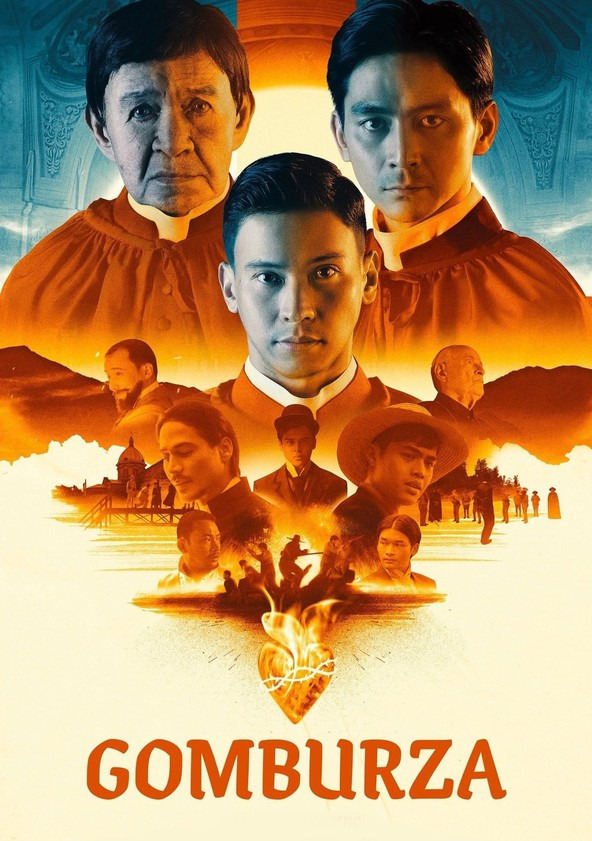
GomBurZa (2023) is a Philippine historical film directed by Pepe Diokno that tells the story of three Filipino priests Mariano Gómez, José Burgos, and Jacinto Zamora, also known as GOMBURZA. The film follows their lives and the events leading up to their execution in 1872 by the Spanish authorities. A moment that inspired the Filipino people to fight for their freedom and became a turning point in Philippine history.
I’m not familiar with the life story of Gomburza, aside from being the inspiration for Jose Rizal to write El Filibusterismo. It was probably the reason why I was able to enjoy the movie despite already knowing how it would end.
It was great to be able to know the story of the three priests that I only learned in passing during my school days. It was only through the movie that I found out some interesting facts about the priests, like their having Spanish ancestry, their ages when they died, and the moment that led to their execution. I should have done my research, I know. I should have been more informed about our national heroes, and spending my college years abroad is not an excuse for not knowing these facts. Didn’t you learn it in high school? To be honest, I don’t remember. I was more familiar with the lives of other notable heroes, like Gregorio Del Pilar, Andres Bonifacio, and, of course, Jose Rizal.
Going back to the film, I believe Cedrick Juan was a good choice for the role of Burgos, despite Enchong Dee being a more popular actor. He wasn’t a familiar face, so it wasn’t difficult for me to see him as Fr. Burgos. Unlike Piolo, despite having a remarkable role as Padre Pedro Pelaez, I only saw Piolo Pascual. It also didn’t help that I watched Mallari before watching Gomburza.
Cedrick’s brilliant portrayal of Padre Burgos gave the character a separate identity away from Gomburza. He wasn’t just a martyr priest; he was a hero, at least in the eyes of his fellow priests, parishioners, and his students, who also tried to fight for equal rights for secular priests.
Padre Gomez was the true epitome of a martyr. Being the oldest, he became the solace of the younger priests, consoling them instead of wasting his time proving his innocence. He willingly accepted his fate and entrusted everything to the Lord. He reminded me of Jesus Christ. To be fair, he was already 72. He had lived a fruitful life and endured enough that he was almost ready to leave (it was still not fair to die that way, though). while Fr. Burgos and Fr. Zamora were only in their thirties. While life may not be ideal, no one’s ready to die that young.
I wish I could find more information about the life of Fr. Zamora. The movie didn’t do him justice. Despite the great performance of Enchong Dee, I felt like Fr. Zamora was treated unfairly both by the Spaniards and the scriptwriter.
Fr. Zamora did not even have the opportunity to say his last words. He was already lifeless, even before he was executed. Being accused of something you didn’t do could cause trauma, let alone be sentenced to death for it.
It reminded me of that time when my third grade teachers embarrassed me in front of the other students and teachers. Two of my classmates fought because of a game. It was one of those stupid games where you would hit the person next to you, and he would pass it on to the person next to him. It was popular at the time, so it wasn’t the first time we played it. I was the unlucky person sitting between my two classmates. As I was busy drawing, I was absentmindedly “passing” the message to the other guy until I got annoyed and stopped. I had no idea what happened after I left them, minding my own business. Before I knew it, they were already hitting each other for real. Our class adviser was called, and my history teacher came too (I’m still confused about why she needed to be there), and they felt that someone should take the blame, and they both decided it would be me because the two were already hysterically crying and mentioning my name, putting the blame on me. For goodness’ sake, I didn’t tell those two morons to kill each other. How did it become my fault? They were the ones who were disturbing me in the first place.
I wasn’t given the opportunity to explain my side, and the angry face of my teacher interrogating me made me a coward. I was a pushover and never had the courage to defend myself back then. I just accepted the unfair treatment and moved on. But I still think of it now, still upset and crying for justice. Before that incident, I dreamed of becoming a teacher, but I had already lost trust in teachers, so I decided to take a different path. This memory came back when I watched the life of Fr. Zamora.
Out of the three, I pity Fr. Zamora the most. He was the most innocent among the priests and was included in the execution because of bad luck. Some even questioned if he deserved the recognition. He only became a martyr due to a wrong timing. But a martyr is someone who became a sacrificial lamb for a supposedly greater good. Fr. Zamora is a martyr. He didn’t need to have a motive to be worthy of the recognition. His death symbolizes the injustices during the Spanish era and how unfair life was. He was a victim of the cruelty of the Spanish government, and his death provoked the Filipino people to rebel against the government.
The actor who played Carlos María de la Torre was another great casting. He looked straight out of a history book, and he resembled the real governor-general a lot. His scenes were some of my favorites. He was a beacon of hope to the Filipinos and even to me as a viewer, at least for a short while, only to be let down.
If Fr. Gomez is Jesus Christ, Dela Torre is Pontius Pilate. His actions, though, were understandable. He was still a Spaniard and was put in a difficult spot. There was a limit to one’s generosity, and he wasn’t willing to risk his life for the Filipinos, who themselves were not willing to fight for their own nation. Besides, what can he do? Next to the highest leader of Spain, the King, his power is nothing.
I can’t even talk about Francisco Zaldua, played by Ketchup Eusebio. I want to feel bad for him, being the fall guy of his rich amigos but I would like to think he got his karma. I believe the reason why he was still executed after providing the Spaniards the needed information to persecute the priests was because they were afraid that he would feel guilty and eventually change his narrative. They needed to eliminate him first to avoid future complication and hide the fact that the priests were really innocent.
It was nice to have a glimpse of Paciano’s life, as I only knew him as Jose Rizal’s brother. In the movie, Paciano brought a young Rizal to witness the execution. Although I read somewhere that the scene was merely fiction. Rizal was not present when the priests were executed. The ending showed an already older Rizal writing El Filibusterismo. At least in the movie, it gave a clear perspective on why Rizal dedicated El Filibusterismo to the martyrs and why he spent his life fighting for reform. He witnessed the cruelty of the Spaniards at a young age. While kids today are watching TikTok videos, he was watching three innocent priests being executed publicly.
Despite being a historical movie, it didn’t have a lot of brutal scenes. Even the execution was brief, which is fine, I guess, as the story was tragic enough.
Gomburza made me realize why the Catholic Church still plays a relevant role in the Philippines today. The Catholic Church is not just a major religion but a part of our history. Although it was used as a weapon to further enslave the indios, the secular priests contributed greatly to the Philippine Revolution.
One of the unforgettable scenes that stuck with me was the conversation between Archbishop Gregorio Martinez and Governor General Rafael Izquierdo. The archbishop said in Spanish,
“Karamihan sa mga indiyo ay hindi magrerebelde. Dahil tayo, ang simbahan, ang nagturo sa kanilang maging masunurin.”
We see history repeating itself everyday. Some churches, not only Catholics, using the Bible to make people submit to church rules, while extorting them using emotional manipulation, which is why it’s important to know our history.
 OC Chronicles
Leave a comment